How Google Detects AI Written Content: The Complete E-E-A-T & Humanization Blueprint (2026)
Quick Takeaway (AEO / Answer Snippet Box):
Google doesn’t punish content just because an AI helped draft it. Instead, search algorithms target low-effort, mass-produced text using systems like SpamBrain and SynthID watermarking. To rank safely in 2026, you need to layer AI-assisted drafts with real human experience, original screenshots, distinct sentence variations, and verifiable E-E-A-T signals.
1. How Google Detects AI Written Content Under the Hood
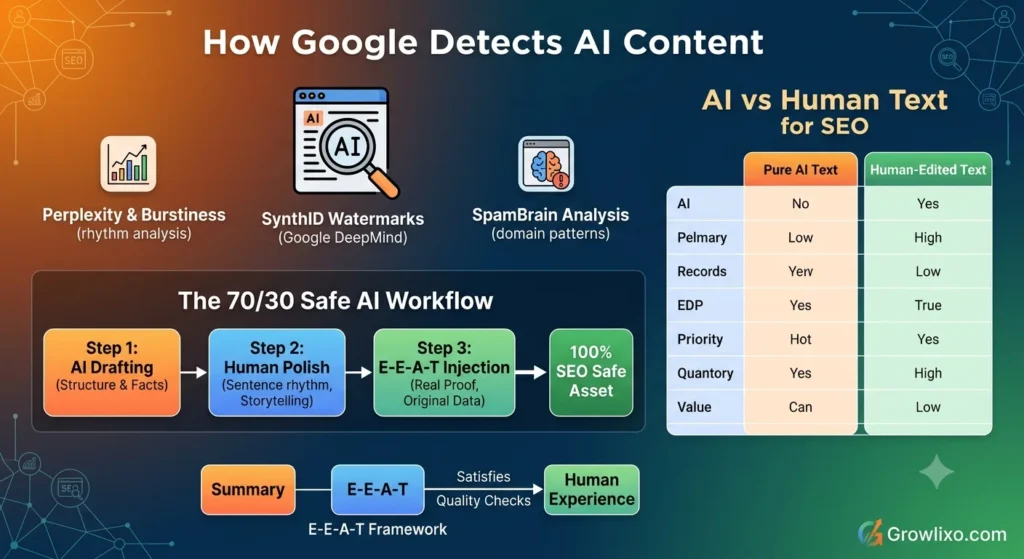
The debate over whether search engines can catch machine-generated text was settled long ago. Google uses a multi-layered detection infrastructure that evaluates your content both at the individual sentence level and across your entire site structure.
                  [ Web Crawler Submits Page ]
                               │
         ┌─────────────────────┴─────────────────────┐
         ▼                                           ▼
[ Syntactic & Pattern Checks ]              [ Watermark & Velocity Scans ]
 ├─ Perplexity & Rhythm Analysis             ├─ SynthID Token Tracking
 ├─ SimHash Content Duplication              └─ SpamBrain Mass-Publishing Monitor
 └─ Predictive Token Mapping
         │                                           │
         └─────────────────────┬─────────────────────┘
                               ▼
                  [ E-E-A-T Score Assignment ]
The Actual Mechanics Google Uses to Identify Machine Text
A. SynthID Cryptographic Watermarking
Google DeepMind built SynthID directly into major Large Language Models (LLMs). When tools like Gemini or ChatGPT generate text, SynthID subtly tweaks the token distribution probabilities. It leaves an invisible digital fingerprint in the text. You can’t spot it with the naked eye, but Google’s indexers read it instantaneously.
B. Perplexity and Burstiness Metrics
Human writing is chaotic, personal, and full of rhythmic shifts. Algorithms look for two main structural telltales:
- Perplexity: Measures how predictable each word choice is. AI picks the mathematically most expected next word, resulting in low, unnatural perplexity.
- Burstiness: Measures how sentence lengths vary. Humans naturally mix 4-word punches with 25-word detailed thoughts. Pure AI text outputs steady 15-to-20 word sentences back-to-back, creating a flat, monotonous cadence.
C. Vector Embeddings and SimHash
Using systems like BERT and MUM, Google maps your entire article’s semantic structure into a vector database. If your page simply rephrases the top 5 search results without contributing new data, Google flags it for having zero Information Gain.
D. SpamBrain & Scaled Content Abuse Signals
Google’s SpamBrain system monitors your publishing habits over time. If a fresh domain suddenly publishes 40 long-form posts a day with identical article layouts, automated site-wide flags kick in regardless of how well the articles are phrased.
2. AI vs Human Content for SEO: What Actually Ranks?
There is a huge misconception that Google hates all machine-assisted text. Google’s guidance is straightforward: Search algorithms reward helpful, high-quality content, no matter how it’s made.
The real divide isn’t how the text was written—it’s how much value it brings to the user.
Comparison: Pure AI vs. Human-Engineered Content
| Search Engine Metric | Pure AI Output | Human-Refined & Edited Content |
| Search Intent Match | Generic summary; repeats standard surface facts. | Direct, practical answers; solves immediate user pain points. |
| Information Gain | None. Re-hashes existing web summaries. | High. Adds new data, original screenshots, or unique angles. |
| Tone & Vocabulary | Stuffed with filler (delve, testament, game-changer). | Natural, sharp, conversational, and direct. |
| Visual Proof | Zero visuals or standard generic stock photos. | Custom infographics, step-by-step UI grabs, real proof. |
| Penalty Risk | High vulnerability to helpful content updates. | Extremely safe; hits search quality benchmarks easily. |
Why “Information Gain” Dictates Rankings
Google owns a patent specifically for Information Gain Scoring. When a user clicks through multiple search results, Google tracks if your page offers something new. Unedited AI output fails here by default because LLMs can only synthesize existing web training data. You must add human commentary, fresh statistics, or personal testing to pull ahead of competitors.
3. Mastering E-E-A-T for AI-Assisted Content
Google’s Quality Raters lean heavily on E-E-A-T: Experience, Expertise, Authoritativeness, and Trustworthiness. AI tools can fake general Expertise by scraping manuals, but they cannot fake real-world Experience.
┌─────────────────────────────────────────────────────────────┐
│                    THE E-E-A-T FRAMEWORK                    │
├──────────────┬──────────────┬────────────────┬──────────────┤
│  EXPERIENCE  │  EXPERTISE   │ AUTHORITATIVE  │ TRUSTWORTHY  │
│ Hands-on     │ Deep Technical│ Industry       │ Clear, Honest│
│ Proof & Trial│ Knowledge    │ Mentions & Links│ & Accurately │
└──────────────┴──────────────┴────────────────┴──────────────┘
Practical Ways to Inject E-E-A-T Signals
1. Prove Hands-On Experience (The First “E”)
AI tools have never installed a plugin, run a speed audit, or bought a budget smartphone. Show that you actually did the work:
- Speak in the first person: “When I tested this caching configuration on my own server…”
- Drop in raw, unedited screenshots with clear annotation arrows rather than generic graphic templates.
- Talk about what broke during your test, not just what worked.
2. Establish Author Authority
Anonymous blogs lose trust quickly in modern search:
- Set up clear author bios that point to active social profiles (LinkedIn, X, YouTube).
- Add proper
PersonandAuthorJSON-LD schema across your site. - Include a short “Reviewed by [Expert Name]” line at the top of technical posts.
3. Build Site Trust (The “T”)
- Link to your Editorial Policy page, explaining transparently that AI assists your research but human editors double-check all facts.
- Keep your “Last Updated” timestamps visible and accurate.
4. How to Bypass AI Detection Safely (Without Cheating Algorithms)
Trying to bypass detection using third-party “AI humanizer” spinners is a losing game. Those tools just swap words for awkward synonyms, which vector search models pick up almost instantly.
True humanization means refining raw AI drafts into polished, high-value editorial assets.
[ 70% Fast AI Draft & Outline ] + [ 30% Human Polish & Proof ] = [ 100% Rankable Content ]
The Step-by-Step Editing Checklist
Step 1: Strip Out “AI Hallmark” Words
AI models rely heavily on repetitive transition words and dramatic fluff. Audit your drafts and delete these words on sight:
- Delve $\rightarrow$ Change to: Look into, explore, examine
- In the fast-paced realm of… $\rightarrow$ Delete completely; state the main point immediately.
- Testament to… $\rightarrow$ Change to: Shows that, proves that
- Furthermore / Moreover / In conclusion $\rightarrow$ Replace with direct conversational transitions.
Step 2: Fix Sentence Rhythm (Increase Burstiness)
Read your draft out loud. If every sentence has roughly the same length, break them up manually:
- Drop short, 3-to-5 word punchy sentences into long sections.
- Give key insights their own single-line paragraphs.
- Use bulleted lists and bold text so readers can scan quickly.
Step 3: Add Custom Proof & Real Data
Unedited AI outputs lack fresh proof points. Boost your drafts by adding:
- Custom comparison tables built from your own research.
- Clean visual step-by-step guides using real UI screenshots.
- Quotes from industry practitioners or direct video walkthroughs.
Step 4: Add Direct Summary Boxes for AEO
To win Google AI Overviews and direct snippets:
- Place a clear 40-to-50 word direct definition immediately under your main subheadings.
- Follow up that quick answer with clear bullet points or structural comparisons.
5. Frequently Asked Questions (FAQs)
Will Google penalize my site if I use AI to write blogs?
No. Google does not penalize sites simply for using AI. Penalties trigger when you publish low-quality, automated, or scaled content that offers zero real value to the reader.
Do free online AI detectors actually work?
Third-party free detectors are notoriously unreliable and frequently flag real human writing as machine-generated. However, Google uses far more advanced systems like SynthID and SpamBrain that analyze deep pattern distributions rather than basic word matching.
Do I need an AI disclosure page on my site?
While Google doesn’t explicitly mandate an AI disclosure tag on standard blogs, adding an Editorial Policy page that explains your human review process builds substantial trust with both readers and quality raters.
Which AI writing tool is safest for SEO?
Tools like Gemini, ChatGPT, and Claude are all safe when treated as research assistants or outline tools. Safety comes entirely down to your editorial editing, fact-checking, and humanization process.
Final Takeaway for Publishers
AI is a powerful accelerator, but it isn’t an autopilot system. If you use machine tools for quick research and structure, and then layer on real human experience, custom proof, and clear formatting, your content on Growlixo will easily clear search quality checks and stay at the top of the SERPs.