What is Search Engine Optimization (SEO)? (An A-to-Z Guide)
Search Engine Optimization target marketing concept with red dart target hitting in bullseye on dartboard and colorful alphabet wood letters SEO over light blurred bokeh background
If you own a website, blog, or online business, your ultimate goal is likely to appear at the top of Google search results whenever potential customers search for services or information related to your industry.
That whole process of making your site visible and ranking higher is called SEO (Search Engine Optimization).
Simple & Direct Definition
Search Engine Optimization (SEO) is the practice of optimizing your website’s content, structure, and authority so that search engines like Google or Bing can easily find, understand, and rank your pages—driving free, organic traffic to your site.
Why is SEO So Important?
When people look for solutions online, they rarely scroll past the first page of Google. In fact, the top three organic results get the vast majority of all clicks.
- Without SEO: Your website remains buried under thousands of competitor pages where no one can find it.
- With SEO: Your site ranks on the first page, consistently driving free visitors, targeted leads, and long-term customers.
The 3 Core Pillars of SEO
To make SEO easy to digest, experts divide it into three primary categories:
1. On-Page SEO
This includes everything you do directly on your website to help search engines understand your content:
- Keyword Optimization: Placing search terms naturally in titles, headers, and content.
- Content Quality: Providing direct, accurate, and comprehensive answers to the reader’s search query.
- Content Structure: Using structured heading tags (
H1,H2,H3) and clear meta descriptions.
2. Off-Page SEO
This focuses on building your website’s reputation and credibility across the broader web:
- Backlinks: Getting trustworthy and high-authority websites to link back to your pages.
- Brand Mentions & Shares: Generating social engagement and online visibility.
3. Technical SEO
This deals with the backend infrastructure of your site to ensure search engine crawlers can scan and index it effortlessly:
- Page Speed: Ensuring fast loading times across all devices.
- Mobile Responsiveness: Delivering a seamless experience for smartphone users.
- Site Architecture: Keeping clean URL structures and providing valid XML sitemaps.
Frequently Asked Questions (FAQs)

Q1. What is the difference between SEO and Paid Ads (PPC)?
Answer: SEO drives organic (free) traffic, which takes time to build but offers long-lasting results. Paid Ads (like Google Ads) place you at the top immediately, but the moment you stop paying for ads, the traffic stops completely.
Q2. How long does it take to see results from SEO?
Answer: For most new or updated websites, noticeable SEO results typically take 3 to 6 months. The exact timeline depends on your industry’s competition, domain authority, and content quality.
Q3. Is SEO still relevant in the age of AI search engines?
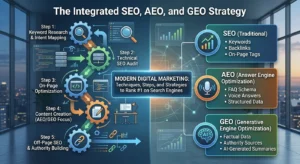
Answer: Yes, absolutely. AI answer engines (such as Google AI Overviews, ChatGPT, and Perplexity) rely on high-quality, structured, and authoritative web content to generate their answers. Modern SEO now encompasses AEO (Answer Engine Optimization) and GEO (Generative Engine Optimization) to ensure your content is cited by AI engines.
4 Actionable Steps to Get Started with SEO
- Conduct Keyword Research: Find out what specific phrases your target audience types into Google.
- Publish Helpful Content: Create well-formatted articles that answer those queries directly and completely.
- Optimize Technical Performance: Make sure your site loads in under 3 seconds and works smoothly on mobile devices.
- Build Internal & External Links: Connect related pages within your site and acquire backlinks from reputable sites in your niche.