7 Emerging Technology Trends That Will Shape the Future
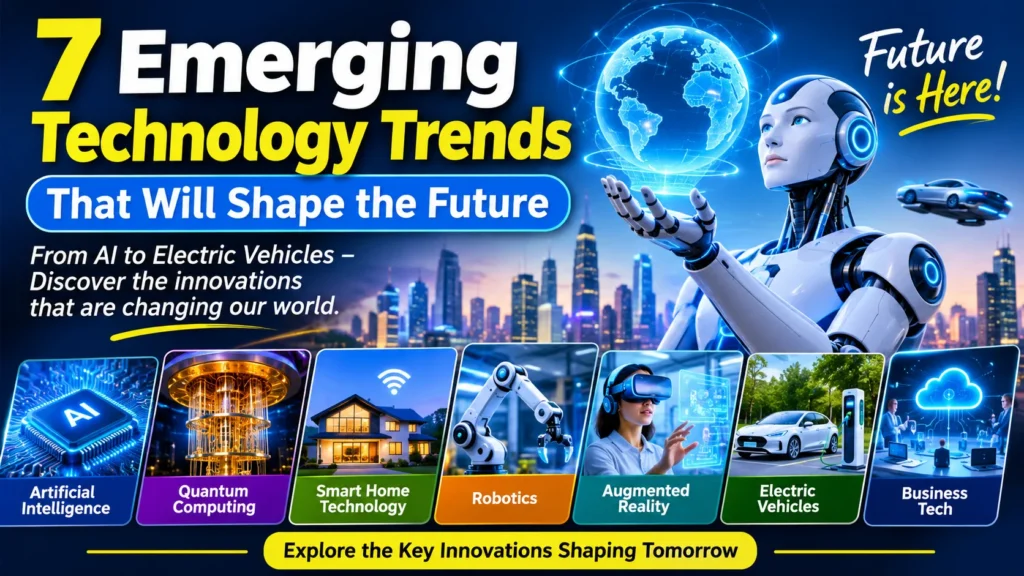
Technology is changing the way people live, work, communicate, and solve everyday problems. From artificial intelligence to electric vehicles, new developments are creating opportunities that were difficult to imagine just a few years ago. Businesses are adopting smarter systems, homes are becoming more connected, and industries such as healthcare and education are exploring new ways to use digital tools.
These changes are not limited to large technology companies. They are gradually becoming part of everyday life in the United States, the United Kingdom, and other parts of the world.
Understanding emerging technology trends can help individuals and businesses prepare for what comes next. Some innovations are already being used, while others are still developing and may take years to become widely available.
Here are seven important technology trends that could shape the future.
1. Emerging Technology Trends That Will Shape the Future
The future of technology will be influenced by several innovations working together. Artificial intelligence, automation, cloud computing, robotics, and connected devices are changing how different industries operate.
Artificial Intelligence and Automation
One major development is the growing use of intelligent software. Businesses can use these systems to organise information, support customer service, analyse data, and complete repetitive tasks. This allows employees to spend more time on activities that require creativity, communication, and decision-making.
Connected Devices and Smart Systems
Another important trend is the development of connected technology. Devices can now exchange information through the internet, helping people control equipment and monitor systems remotely.
For example, modern industries use connected sensors to monitor machines and identify possible maintenance problems. This can help reduce unexpected interruptions and improve daily operations.
Technology and Environmental Sustainability
Technology is also becoming more important in environmental management. Better energy monitoring, smart electricity systems, and improved battery technology may help communities use resources more efficiently.
However, new technology also creates challenges. Data protection, online security, employment changes, and responsible development will remain important issues.
The future will not depend only on how advanced technology becomes. It will also depend on how responsibly people and organisations use it.
2. How Quantum Computing Will Change the World?
Quantum computing is one of the most interesting areas of modern computer science. Unlike traditional computers, which process information using bits represented as either zero or one, quantum computers use quantum bits, commonly known as qubits.
Qubits can use quantum properties such as superposition and entanglement. These properties allow quantum systems to approach certain complex computational problems differently from conventional computers.
Potential Applications of Quantum Computing
One potential application is scientific research. Researchers are exploring how quantum computing could help simulate molecules and chemical reactions. This may eventually support the development of new materials, medicines, and energy technologies.
The financial industry is another area of interest. Researchers are investigating possible uses in optimisation, risk analysis, and complex financial modelling.
Quantum Computing and Cybersecurity
Cybersecurity may also experience significant changes. Some quantum algorithms could threaten widely used public-key encryption methods. As a result, organisations are developing post-quantum cryptography to protect sensitive information against future threats.
Challenges of Quantum Technology
Despite its potential, quantum computing is not ready to replace ordinary computers. Building stable and reliable quantum systems remains difficult. Errors, environmental interference, and technical complexity are major challenges.
For now, quantum computing should be viewed as an emerging research field rather than a technology that will immediately change every industry.
3. How Smart Home Technology Is Changing Modern Living
Smart home technology is making everyday household activities more convenient. It allows people to connect devices such as lighting systems, thermostats, security cameras, door locks, and home appliances through digital networks.
Smart Lighting and Temperature Control
One common example is smart lighting. Homeowners can control lights through mobile applications or voice commands. Some systems also allow automatic schedules based on daily routines.
Smart thermostats offer another useful feature. They can help households manage indoor temperatures and monitor heating patterns. When configured correctly, these systems may reduce unnecessary energy consumption.
Smart Home Security Systems
Home security is also changing. Connected cameras, motion sensors, and smart doorbells allow residents to receive alerts and check their property remotely.
In the UK and USA, smart home devices are becoming increasingly relevant to people interested in convenience, home monitoring, and energy management.
Privacy and Security Challenges
However, connected homes require careful attention to privacy and security. Devices that use weak passwords or outdated software may create opportunities for unauthorised access.
Homeowners should choose reputable products, install security updates, and use strong passwords. It is also sensible to review which devices have permission to access personal information.
Smart home technology is not simply about controlling appliances remotely. Its wider purpose is to make homes more comfortable, manageable, and efficient.
4. Future of Robotics in Healthcare and Education
Robotics is becoming an important part of discussions about the future of healthcare and education. Robots can perform specific tasks with accuracy and consistency, making them useful in environments where efficiency and precision matter.
Robotics in Modern Healthcare
In healthcare, robotic systems are already being used in certain surgical procedures. These systems allow trained surgeons to control specialised instruments with high precision.
Robots can also support rehabilitation. Some devices help patients practise movements after injuries or neurological conditions. Their purpose is to assist treatment under professional supervision, not replace medical experts.
Another developing area is hospital logistics. Automated machines can help transport supplies, equipment, and other materials between departments.
Educational Robots in Classrooms
Education is exploring different uses of robotics as well. Students can learn programming, engineering, problem-solving, and basic mechanical concepts through educational robot kits.
Robotics can also make classroom activities more interactive. Teachers may use simple programmable machines to explain scientific concepts and encourage practical learning.
Challenges of Using Robotics
However, there are limitations. Healthcare robots require careful testing, professional supervision, and reliable maintenance. Educational institutions must also consider equipment costs and teacher training.
Robotics is likely to become a more useful supporting tool in both industries, especially where repetitive tasks or practical learning activities are involved.
5. How Augmented Reality Is Changing Everyday Life
Augmented reality, commonly called AR, adds digital information to a person’s view of the real world. It is different from virtual reality because users can still see their physical surroundings while interacting with digital elements.
Augmented Reality in Shopping
Smartphone applications have made augmented reality more familiar to everyday users. For example, some shopping applications allow customers to preview how furniture might look inside their homes before making a purchase.
This feature can help people make better buying decisions because they can compare products with their existing furniture and room layout.
AR in Education and Training
Education is another area where AR has useful potential. Students can explore interactive models of planets, historical objects, and scientific structures through compatible devices.
Businesses can also use augmented reality for product demonstrations and employee training. Workers may follow digital instructions displayed over real equipment, helping them understand complicated procedures.
Challenges Facing Augmented Reality
In healthcare, AR is being explored for medical education, visual guidance, and other specialist applications.
Although the technology offers exciting possibilities, it still faces challenges. Hardware costs, software compatibility, battery performance, and user privacy can affect adoption.
As devices improve, augmented reality may become a more common part of shopping, education, entertainment, and professional training.
6. How Electric Vehicle Technology Is Improving
Electric vehicles are becoming an important part of the global automotive industry’s transition towards alternative energy systems.
Unlike conventional petrol and diesel vehicles, fully electric vehicles use rechargeable batteries to power electric motors.
Improvements in Electric Vehicle Batteries
One important area of development is battery technology. Manufacturers and researchers are working to improve battery capacity, charging performance, durability, and manufacturing costs.
Expansion of Electric Vehicle Charging Networks
Charging infrastructure is also expanding in different markets. More public charging locations can make electric vehicles practical for people who cannot charge their cars at home.
Smart Features in Modern Electric Cars
Another development is smarter vehicle software. Modern electric cars often include digital dashboards, navigation systems, driver assistance features, and software updates.
These features can improve the driving experience and help drivers monitor energy consumption.
The UK and USA are important markets for electric vehicle development, although adoption depends on factors such as vehicle prices, charging access, electricity costs, and government policies.
Challenges Facing Electric Vehicle Technology
Electric vehicles still have limitations. Charging can take longer than refuelling a traditional car, particularly when using slower chargers. Battery production and recycling also require attention because they involve materials and environmental considerations.
Future improvements in batteries, charging networks, and recycling systems could make electric transportation more practical for a wider range of drivers.
7. Technologies That Will Transform Businesses in the Future
Businesses are increasingly using digital technology to improve their operations, understand customers, and compete in changing markets.
Artificial Intelligence in Business Operations
Artificial intelligence is one of the most influential developments. Companies can use AI-powered software to analyse customer behaviour, organise information, support marketing activities, and improve customer service.
Cloud Computing and Remote Collaboration
Cloud computing is another important technology. Instead of keeping all business information on local computers, organisations can use online infrastructure to store files, run applications, and collaborate with employees from different locations.
Business Automation and Productivity
Automation is also changing business operations. Repetitive administrative activities, inventory tracking, and certain customer support tasks can be handled through automated systems.
Cybersecurity for Future Businesses
Cybersecurity will become even more important as businesses depend on digital platforms. Protecting customer information, payment details, and internal documents is essential for maintaining trust.
Small businesses can benefit from these developments too. They do not always need expensive infrastructure to start using digital tools. Affordable cloud services, online communication platforms, and automation software can help smaller teams manage their work.
Nevertheless, technology investments should be based on real business needs. Buying complicated software without proper planning can increase costs instead of improving productivity.
Companies that combine suitable technology with employee training and responsible data management will be better prepared for future changes.
8. What Should We Expect From Technology in the Coming Years?
The next stage of technological development will probably involve more connections between different systems. Artificial intelligence may work alongside robotics, smart devices may become more integrated, and businesses may increasingly rely on cloud-based services.
Healthcare could benefit from better digital tools, while education may offer more interactive learning experiences. Transportation may continue moving towards electric power, and homes may become more efficient through connected devices.
However, technological progress will not happen at the same speed everywhere. Costs, infrastructure, regulations, and public acceptance will influence how quickly new innovations become part of everyday life.
People should also develop digital skills to understand these changes. Learning about cybersecurity, AI tools, online privacy, and modern software can help individuals make more informed decisions.
The most successful innovations will not necessarily be the most complicated ones. They will be the technologies that solve genuine problems and provide practical value.
9. Frequently Asked Questions (FAQs)
What Are the Most Important Emerging Technology Trends?
Artificial intelligence, quantum computing, robotics, augmented reality, smart home systems, electric vehicles, and cloud computing are among the important emerging technology areas.
How Will Technology Change Everyday Life in the Future?
Technology may make communication, transportation, healthcare, education, and household management more convenient through connected devices and intelligent software.
Will Quantum Computing Replace Traditional Computers?
Quantum computers are designed for certain specialised computational problems. They are not expected to replace traditional computers for everyday activities such as browsing, writing, and general office work.
How Can Small Businesses Benefit From New Technology?
Small businesses can use cloud platforms, automation tools, AI software, and digital communication systems to manage tasks, improve customer service, and organise business operations.
Is Electric Vehicle Technology Improving?
Yes. Research and development continue in battery performance, charging infrastructure, vehicle software, and battery recycling.
10. Final Thoughts
Technology is developing across almost every industry, creating new possibilities for individuals, businesses, and communities. From quantum computing and robotics to smart homes and electric vehicles, these innovations could influence how people approach everyday activities in the coming years.
Although some technologies are still in their early stages, understanding their potential and limitations is important. Businesses and individuals that stay informed, develop digital skills, and make thoughtful technology choices will be better prepared for the future.