AI SEO Growth Framework for Startups and SaaS in 2026
Search Engine Optimization target marketing concept with red dart target hitting in bullseye on dartboard and colorful alphabet wood letters SEO over light blurred bokeh background
Search is not what it was two years ago. Answer engines, AI Overviews, and conversational assistants now sit between your content and the person searching for it, and that single shift has rewritten the rulebook for organic growth. For startups and SaaS companies operating on lean budgets and tight timelines, this is either a threat or an enormous opportunity — depending on whether you adapt your approach.
This guide lays out a practical, end-to-end AI SEO growth framework built specifically for startups and SaaS businesses heading into 2026. Whether you’re building this in-house, hiring AI SEO Services, or partnering with a dedicated AI SEO agency, the principles below will help you structure a strategy that actually compounds instead of one that chases algorithm updates forever.
Why “Old SEO” No Longer Works Alone
Traditional SEO was built around a simple loop: research keywords, write content around them, build backlinks, and wait for rankings to climb. That loop still matters, but it’s no longer sufficient on its own.
Three structural changes have reshaped the landscape:
- AI-generated answers now sit above organic results. Many queries are answered directly inside the search results page, meaning fewer clicks reach your website even when you rank well.
- Search intent has become conversational. People ask fuller, more natural questions, and large language models parse meaning rather than just matching keywords.
- Content volume has exploded. AI tools make it trivial to produce content at scale, which means quality, structure, and trust signals now matter more than raw output.
For SaaS companies especially, this means visibility isn’t just about ranking for “best project management software.” It’s about being the source that AI systems reference, cite, and recommend when someone asks a related question in ChatGPT, Perplexity, or Google’s AI Overview.
The Core Shift: From Keyword SEO to Entity and Answer SEO
The foundation of any modern strategy — whether you build it yourself or bring in an AI SEO agency — is understanding that search engines and AI models now think in terms of entities, relationships, and answers rather than isolated keywords.
This means your content needs to:
- Clearly define what your product is, who it’s for, and what problem it solves, in a way that’s unambiguous to machines.
- Build topical authority across a cluster of related questions, not just a handful of high-volume keywords.
- Structure information so it can be easily extracted and summarized by AI systems (clear headers, direct answers, well-organized data).
This is the mental model your entire framework should be built around.
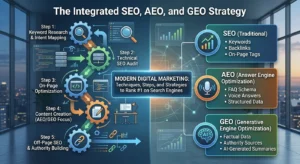
The 2026 AI SEO Growth Framework
Below is a five-stage framework designed specifically for startups and SaaS teams that need results without a massive internal team.
Stage 1: Foundation — Technical and Entity Setup
Before content or links matter, your site needs to be machine-readable and unambiguous. This stage is often where AI SEO Services provide the most immediate value, since technical gaps quietly cap everything built on top of them.
Key priorities:
- Structured data everywhere. Schema markup (Organization, SoftwareApplication, FAQ, Product) helps both traditional crawlers and AI models understand exactly what your page represents.
- Clean crawlability. Fast load times, clear internal linking, and a logical site architecture remain non-negotiable — AI-driven search doesn’t remove the need for technical hygiene, it raises the bar.
- A consistent entity presence. Your company name, product description, and value proposition should be consistent across your website, directories, review sites, and social profiles. AI models cross-reference these sources to build confidence in what you actually do.
- llms.txt and AI crawler access. An increasing number of SaaS companies now maintain a simple file signaling how AI crawlers should treat their content, alongside standard robots.txt configuration.
Stage 2: Topical Authority Mapping
Rather than targeting individual keywords, map out the full universe of questions your ideal customer asks across their buying journey — from “what is [category]” all the way to “[your product] vs [competitor].”
A useful approach:
- Build a topic cluster map, not a keyword list. Group related questions under core pillar pages.
- Include comparison and alternative content. SaaS buyers frequently search “[competitor] alternative” or “[category] tools compared” — these pages are high-intent and increasingly referenced by AI answer engines.
- Cover the full funnel. Educational content earns trust and citations; bottom-funnel content (pricing pages, use-case pages, integration pages) converts once trust is established.
This is precisely the kind of structural work that specialized SEO For SaaS Companies engagements focus on, since SaaS buying cycles are longer and more research-heavy than typical e-commerce or local business search behavior.
Stage 3: AI-Optimized Content Creation
Content in 2026 needs to satisfy two audiences at once: human readers and AI summarization systems. That means:
- Answer the question in the first two or three sentences, then expand with supporting detail. AI systems tend to extract the most direct, well-structured answer available.
- Use clear, descriptive subheadings that mirror how people actually phrase questions.
- Back claims with original data, screenshots, or first-hand experience. Generic, derivative content is easy for AI models to deprioritize since it adds no new information to what’s already indexed.
- Keep a consistent point of view. Thin, generic listicles are being squeezed out in favor of content that demonstrates real expertise and a distinct perspective — something templated content simply can’t replicate.
For startups without an internal content team, this is often the stage where working with an AI SEO agency pays off fastest, since experienced teams already know how to structure content that satisfies both ranking algorithms and AI extraction systems simultaneously.
Stage 4: Authority and Citation Building
Links still matter, but in an AI-driven search landscape, being cited matters just as much as being linked to.
Focus on:
- Digital PR and original research. Publishing original data, benchmarks, or surveys gives journalists, bloggers, and AI systems something concrete to reference and quote.
- Community and review presence. Being present and well-reviewed on platforms like G2, Capterra, and relevant community forums directly influences how AI models perceive your credibility, since these platforms are frequently pulled into AI-generated answers.
- Founder and expert visibility. Guest contributions, podcast appearances, and thought leadership content build the kind of real-world authority signals that are difficult to fake at scale.
Stage 5: Measurement Beyond Rankings
Traditional rank tracking alone no longer tells the full story. A modern measurement stack should include:
- AI visibility tracking — monitoring whether and how your brand appears in AI Overviews, ChatGPT, and Perplexity responses for relevant queries.
- Share of voice by topic cluster, not just individual keyword position.
- Assisted conversions from organic and AI-referred traffic, since the buyer journey may now start in an AI chat interface rather than a traditional search results page.
- Content decay monitoring, refreshing pages that are losing visibility before they drop out of the conversation entirely.
Building This In-House vs. Hiring Help
Startups typically face one of three paths:
Path 1: Fully in-house. Works well if you already have a strong content or marketing hire who understands both SEO fundamentals and how AI search behaves. Requires more ramp-up time.
Path 2: Hire specialized AI SEO Services. A good middle ground for startups that need specific technical or content execution (structured data implementation, content audits, AI visibility tracking) without committing to a full agency retainer.
Path 3: Partner with a dedicated AI SEO agency. Makes sense for SaaS companies that want a complete, managed strategy — especially one experienced in SEO For SaaS Companies, since SaaS growth has unique characteristics: longer sales cycles, developer-focused content needs, integration and API documentation SEO, and comparison-heavy buyer research.
Whichever path you choose, the questions to ask remain the same: Does this team or provider understand entity-based SEO? Can they show experience with AI visibility, not just traditional rankings? Do they understand SaaS-specific buying behavior, or are they applying a generic playbook?
Common Mistakes Startups Make in 2026
- Chasing keyword volume over intent. A page ranking for a high-volume term that doesn’t match buyer intent won’t convert, and increasingly won’t get chosen by AI systems either.
- Publishing AI-generated content without differentiation. Volume without originality is now a liability, not an asset.
- Ignoring technical foundations. No amount of content strategy compensates for a slow, poorly structured site.
- Treating SEO as a one-time project. AI search evolves quickly; the framework above needs quarterly review, not a single setup-and-forget implementation.
- Underinvesting in brand and citation signals. In an AI-mediated search world, being trusted matters as much as being optimized.
Putting It All Together
The startups and SaaS companies that win organic growth in 2026 won’t be the ones who write the most content or chase the newest algorithm hack. They’ll be the ones who build a genuinely authoritative, well-structured, entity-clear presence that both humans and AI systems can trust and reference.
Start with your technical foundation, map your topical authority around real buyer questions, create content built for both readers and AI extraction, build genuine citation and authority signals, and measure visibility beyond just rankings. Whether you execute this framework internally, bring in focused AI SEO Services, or partner fully with an experienced AI SEO agency that understands SEO For SaaS Companies, the underlying principles stay the same — and they’re the ones that will keep paying off well beyond 2026.