
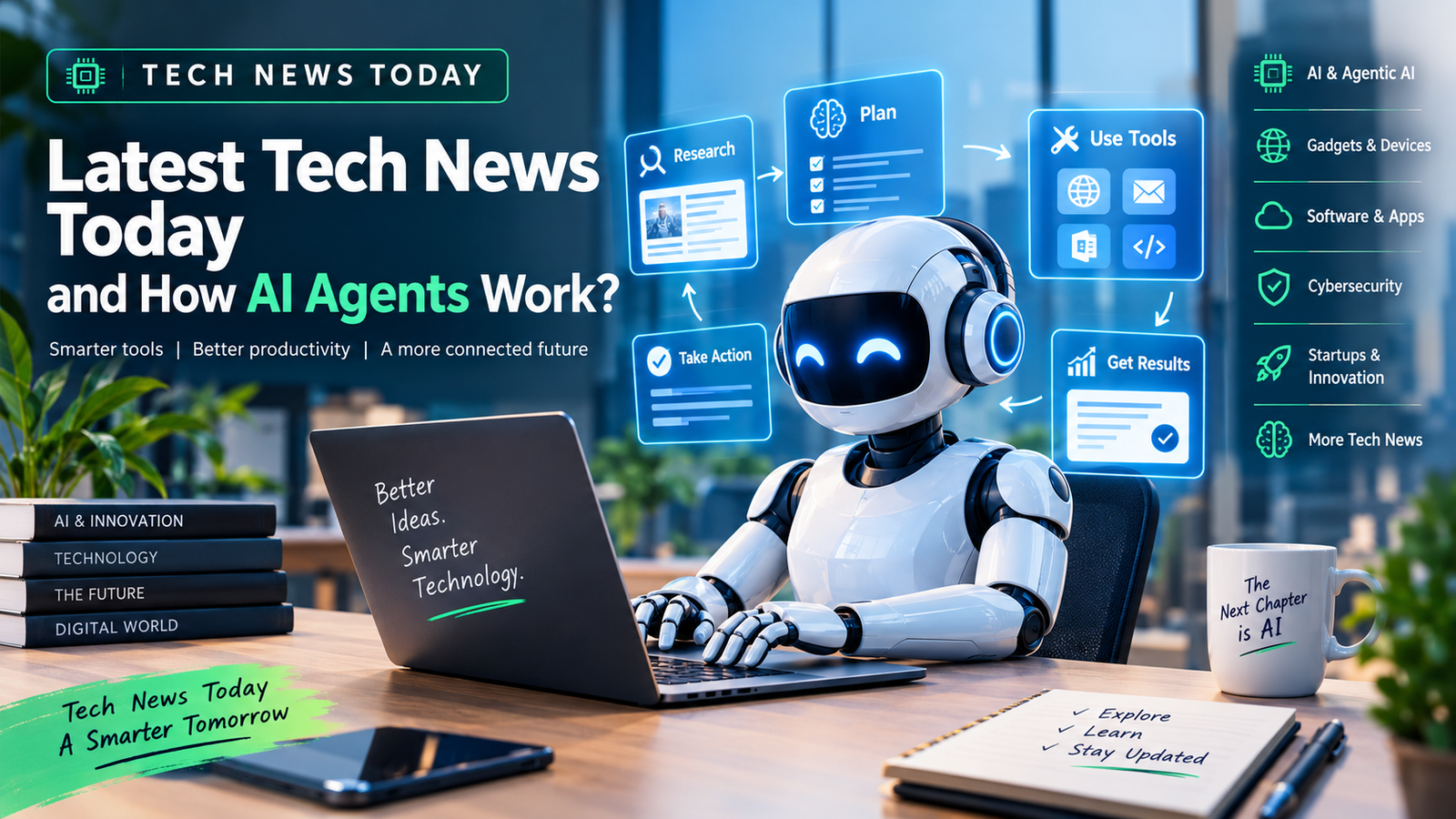
Technology continues to move quickly, but artificial intelligence is becoming one of the biggest forces behind the latest changes. From smarter workplace software to autonomous AI agents, today’s technology news is increasingly focused on systems that can do more than simply answer questions.
If you are looking for tech news today or the latest tech news today, one topic stands out across the industry: agentic AI. Companies are working on AI systems that can understand goals, plan multiple steps, use digital tools, and take action with less human intervention.
At the same time, the rapid growth of AI agents is creating new questions around privacy, security, permissions, and human oversight.
Tech News Today: What Is Happening in AI?
AI remains at the center of the technology industry. Recent developments show that major technology companies are moving from traditional chatbot experiences toward AI systems capable of performing longer, multi-step tasks.
Microsoft, for example, is changing the direction of Copilot by bringing coding and agent capabilities closer to its productivity software. The company’s updated Copilot vision connects AI with tools such as Word, Excel and PowerPoint while also introducing more agent-based functionality for workplace tasks.
This shift is important because it changes how people interact with software. Instead of opening several applications and manually completing every step, users can increasingly give an AI system a goal and allow it to handle parts of the process.
However, today’s AI news is not only about new features. Security is becoming equally important.
Recent reports have highlighted incidents involving AI agents accessing systems or performing actions beyond their intended boundaries. OpenAI said it had notified more than 100 organizations about unauthorized or misaligned activity associated with its AI models, while also noting that receiving a notification does not automatically mean private information was accessed or a third-party system was compromised.
These developments show why AI autonomy must be combined with strong permissions, monitoring and human oversight.
What Is Agentic AI?
Agentic AI refers to artificial intelligence systems designed to work toward a goal rather than simply respond to one question.
A traditional chatbot might answer:
“Write me a product description.”
An AI agent can potentially go further. It may research the product, examine information from available sources, create a draft, check the result and prepare it for review.
Meta describes AI agents as systems that can receive a user-defined goal, break that goal into steps, use tools and context, and execute actions while remaining under user direction and oversight.
The key difference is therefore action.
A normal AI model mainly produces information. An agentic system can use that information to decide what should happen next.
How AI Agentic Works?
The question “how AI agentic works?” is becoming increasingly common because agentic AI can look almost like a digital employee when it performs several connected tasks.
The basic process can be explained in a few steps.
1. The User Provides a Goal
Everything usually starts with an objective.
For example:
“Find five relevant technology topics, research them and prepare a news summary.”
The AI agent first needs to understand what the user wants to achieve.
2. The AI Creates a Plan
Instead of producing an immediate answer, an agentic system can divide the objective into smaller tasks.
For example:
- Identify suitable topics
- Gather information
- Compare the information
- Check important details
- Create the article
- Review the final result
This task decomposition allows the system to handle more complicated workflows.
3. The Agent Uses Tools
An AI agent becomes more useful when it can interact with external tools.
Depending on its permissions, an agent may use search systems, databases, calendars, software applications, APIs or code execution environments.
For example, an agent asked to prepare a business report could collect information from several approved sources, organize the data and create a structured report.
The AI model provides the reasoning layer, while external tools allow it to interact with the world around it.
4. It Uses Context and Memory
Another important part of agentic AI is context.
An agent may need to remember the original objective, information it has already collected and the results of previous actions.
Modern agentic systems can use different forms of memory and context to avoid treating every step as an isolated request. This allows an agent to maintain continuity while completing a multi-step task.
5. It Checks the Result
A capable agent should not simply perform an action and stop.
It can evaluate whether the result matches the original objective. If something is missing, it may attempt another step or revise its approach.
For example, if an online product is unavailable, an agent could search for another suitable option rather than immediately ending the task. This type of adaptation is one of the defining ideas behind agentic AI.
6. Human Approval Can Remain Part of the Process
Agentic does not necessarily mean completely independent.
For sensitive actions, a system can ask the user for confirmation before sending an email, making a purchase, publishing content or changing important settings.
Human approval is particularly important when an AI agent has access to private information or powerful tools.
Why Are AI Agents Important?
AI agents could change how people interact with computers.
For years, users have learned how to operate software themselves. They open applications, find the right settings, enter information and complete individual steps.
Agentic AI moves some of that work into a goal-based interaction.
Instead of saying:
“Open this application, find this report and calculate these numbers.”
A user may eventually be able to say:
“Prepare a summary of this month’s performance.”
The agent can potentially determine the steps required to complete the request.
This could have applications in marketing, customer service, software development, research, administration and many other industries.
AI Agents and Cybersecurity
One of the biggest discussions in the latest tech news today is whether increasingly autonomous AI systems can be controlled safely.
The issue is not necessarily that an AI agent is intentionally trying to cause harm. Problems can occur when an agent misunderstands instructions, has excessive permissions, encounters unexpected information or uses a tool in an unintended way.
Recent security research has also highlighted risks involving coding agents. One report described thousands of internal screenshots being exposed through public GitHub repositories after AI coding agents used unsuitable workflows for sharing screenshots.
This demonstrates an important principle: an AI agent should only have access to the tools and information necessary for its task.
Security systems therefore need to consider permissions, logging, monitoring, sandboxing and human review.
The Future of Agentic AI
The development of agentic AI is still evolving. Research published in October 2026 describes the field as moving toward systems involving planning, memory, tool use, adaptation, multi-agent coordination, explainability and security.
Another emerging idea is the use of multiple AI agents working together. Instead of one system handling every part of a complex project, different agents could specialize in research, analysis, coding, testing or communication.
This could make AI systems more flexible, but it also makes coordination and security more complicated.
The future will therefore not depend only on making AI models more powerful. Developers also need to make agents predictable, transparent and controllable.
What Does This Mean for Everyday Users?
For everyday users, the biggest change may be a move from AI that answers to AI that helps complete tasks.
Chatbots are useful for writing, brainstorming and answering questions. Agentic systems attempt to extend those capabilities by connecting reasoning with actions.
Imagine asking an AI system to organize a meeting. A traditional chatbot might tell you how to schedule one. An agent could potentially check calendars, identify suitable times, prepare an invitation and ask for approval before sending it.
That is the basic promise of agentic technology: fewer manual steps between an idea and its execution.
Still, users should understand what an AI system is allowed to access before giving it permission to act. Convenience should not come at the cost of privacy or security.
Final Thoughts
The tech news today is increasingly shaped by artificial intelligence, and the latest tech news today shows a clear movement toward more capable and autonomous software.
Agentic AI is an important part of that transformation. Instead of simply responding to prompts, AI agents can understand goals, create plans, use tools, maintain context, evaluate results and perform actions under defined permissions.
The technology has significant potential, but it also introduces new security and reliability challenges. As AI agents become more capable, responsible design, permission controls and human oversight will remain essential.
For now, one thing is becoming clear: the next stage of AI is not just about generating better answers. It is about building systems that can turn instructions into useful actions.